Why Laravel is the Perfect Framework for Scalable Web Applications?
In today’s digital age, scalability isn’t just a “nice-to-have” — it’s a necessity. Whether you’re building the next social media platform or a SaaS product for businesses, your web application needs to grow with your user base without breaking under pressure. When it comes to building scalable web applications with speed and elegance, Laravel development services out as a preferred framework.
In this blog, we’ll explore why Laravel development services are the perfect foundation for applications that demand performance, flexibility, and growth.
What Does It Mean to Scale a Web Application?
Before diving into Laravel’s strengths, let’s define scalability in web development.
Scalability refers to a system’s ability to handle an increasing number of users, requests, and data—without a significant drop in performance or stability. This capability can be achieved in two ways:
- Vertical Scaling: Adding more resources (CPU, RAM) to the existing server.
- Horizontal Scaling: Adding more servers and distributing the load.
A scalable application must be well-structured, modular, and easy to adapt to infrastructure changes. And that’s where the Laravel framework for scalable applications shines.
Laravel’s Robust Architecture for Growth
Laravel is built on the Model-View-Controller (MVC) design pattern — a proven software architecture that promotes code separation, maintainability, and clarity. This clean separation of concerns allows development teams to scale their codebase more efficiently.
Laravel also uses service containers and dependency injection, making it easier to manage large, complex applications. The modular structure allows developers to split functionality into packages, meaning you can grow your app feature by feature — without rewriting core logic.
Laravel Development Services are just a few clicks away.
Get Yours today!
Key Features of Laravel Framework for Scalable Applications
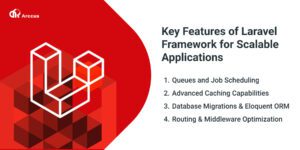
Laravel development services excel at creating scalable applications. Here’s the key feature of laravel for scalable web applications:
1. Queues and Job Scheduling
Scalable applications often need to offload time-consuming tasks such as sending emails, generating reports, or processing images. Laravel application development’s built-in queue system allows you to defer such jobs, improving response times and overall app performance. Laravel also includes an expressive job scheduler for automating repetitive tasks.
2. Advanced Caching Capabilities
Laravel supports a variety of cache drivers, including Redis and Memcached, which allow you to cache data efficiently and reduce database load. Whether it’s user sessions, rendered views, or query results, caching in Laravel significantly boosts scalability.
3. Database Migrations & Eloquent ORM
Laravel’s migration system lets you version and control database schema changes easily. With Eloquent ORM, you get an elegant syntax for managing data relationships and queries — making it easier to manage complex databases as your app grows.
4. Routing & Middleware Optimization
Laravel’s flexible routing system paired with middleware allows you to control request lifecycle behavior and add features like authentication, throttling, and logging — all in a highly scalable fashion.
The Laravel Ecosystem: Built for Big Things
Laravel has grown beyond being a simple PHP framework. It’s a full-fledged ecosystem of developer-friendly tools that empower teams to build, scale, and maintain enterprise-grade applications with ease. What sets Laravel apart isn’t just elegant syntax or MVC structure — it’s the tight integration of complementary tools designed for performance, scalability, and developer productivity.
Below is a breakdown of some of the most powerful tools within the Laravel application development and Laravel web development that make it enterprise-ready:
1. Laravel Horizon—Redis Queue Monitoring Made Easy
Laravel Horizon is a beautifully designed dashboard and code-driven configuration system for managing Redis queues.
Why it matters:
- Gives real-time insights into queue health and performance.
- Tracks jobs, throughput, and failures in a clean UI.
- Supports auto-scaling of workers in long-running applications.
- Allows tagging of jobs, letting you filter and monitor specific tasks.
- Provides detailed metrics, enabling fine-grained monitoring and debugging.
Use case:
Large-scale applications with email queues, video processing, or real-time events benefit from Horizon’s simple visibility and management tools, helping ensure smooth operation under high loads.
2. Laravel Nova—Admin Panels, Reimagined
Laravel Nova is a sleek administrative dashboard builder designed for Laravel. It allows developers to create powerful back-office interfaces with minimal code.
Why it matters:
- Built specifically for Laravel — integrates seamlessly with Eloquent models.
- Offers resource management, CRUD operations, and relationship handling out of the box.
- Extensible with custom fields, actions, metrics, lenses, and filters.
- Automatically respects authorisation policies and gates.
- It comes with advanced UI components for metrics and charts.
Use case:
Perfect for startups and enterprise teams alike, Nova drastically reduces the time spent building internal tools or custom dashboards while still offering deep customisation.
Want to Know more about Laravel Development services
Ping us now!
3. Laravel Vapor—Serverless Laravel at Scale
Laravel Vapor is a serverless deployment platform for Laravel powered by Amazon Web Services (AWS). It abstracts away infrastructure management while offering massive scalability.
Why it matters:
- Zero server maintenance — scales automatically with demand.
- Built-in support for S3, RDS, CloudFront, Lambda, and more.
- Handles queues, databases, storage, and cache with native Laravel configuration.
- Allows you to deploy globally with AWS’s global infrastructure.
- Ideal for building modern, elastic applications without DevOps overhead.
Use case:
E-commerce platforms, SaaS products, or any Laravel app expecting high traffic spikes benefit from Vapor’s automatic scaling and managed infrastructure — all while writing standard Laravel code.
4. Laravel Octane—Performance on Steroids
Laravel Octane boosts Laravel’s performance by running it on high-speed application servers like Swoole or RoadRunner.
Why it matters:
- Significantly reduces request/response cycle time by keeping the application in memory.
- Supports concurrent tasks and coroutine-based execution.
- Increases throughput, ideal for real-time APIs and event-driven apps.
- It improves boot time by eliminating repeated framework initialisation.
Use case:
API-heavy applications, real-time apps (like chat, gaming, or streaming), and apps with high concurrent user traffic see dramatic performance improvements with Octane.
With these powerful tools at your disposal, Laravel application development or Laravel web development can rival—and often outperform—other complex ecosystems like Node.js, Ruby on Rails, and Java Spring. Developers can enjoy both developer satisfaction and production-level scalability with Laravel.
Is Laravel Always the Right Choice?
While Laravel is ideal for many scenarios, it’s worth noting that for ultra-low-latency or highly distributed microservices systems, alternatives like Node.js or Go might be considered. However, Laravel is highly versatile and continues to evolve with features (like Octane and Vapor) that make it suitable for even the most demanding applications.
Start Building with Confidence—Your App’s Future is in Good Hands
Laravel is more than just a web framework — it’s a developer experience built for growth. With its clean architecture, powerful features, and robust ecosystem, Laravel application development makes it easier than ever to build applications that scale — whether you’re handling hundreds or millions of users.
If scalability, performance, and development speed are on your checklist, Laravel is a framework worth betting on.